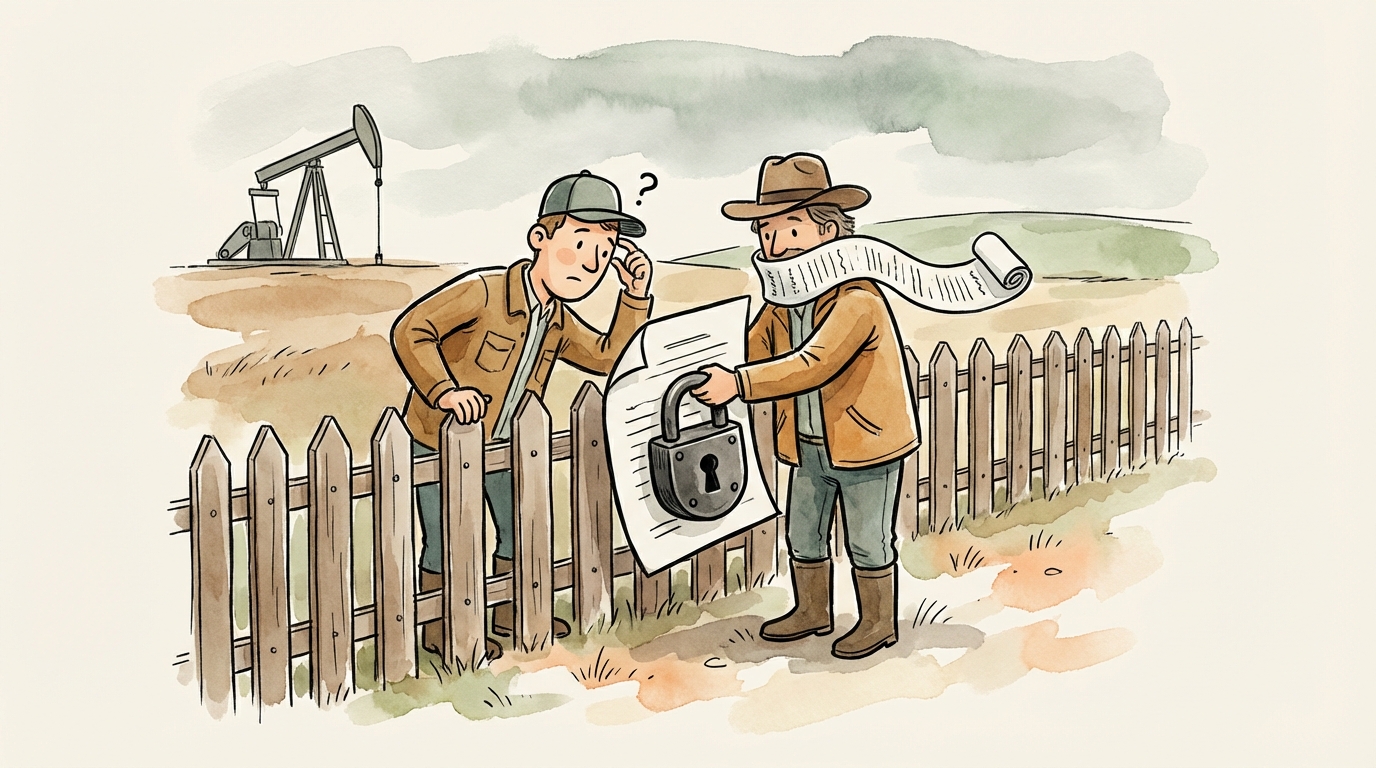
My neighbor gets paid more, but nobody can show me the lease.
We hear some variation of this sentence all the time when we talk to families in Pennsylvania. You suspect you are being underpaid. You know the operator is pulling heavy deductions out of your check before you ever see a dime. You talk to a neighbor down the road, and they hint that their deductions are capped, or their royalty percentage is higher.
Naturally, you ask to see their paperwork so you can compare notes.
They freeze. They stammer. They tell you they legally aren’t allowed to show you.
Welcome to the modern oil and gas lease in the Marcellus Shale. Over the past decade, operators have systematically deployed a stack of legal provisions designed to keep mineral owners isolated, underpaid, and quiet. We call it the “Gag Clause” regime. It is a highly effective, legally enforceable system that turns the act of simply getting paid what you are owed into a lonely, overwhelmingly expensive hobby.
Let’s break down exactly how this machine works, why it is so prevalent in Pennsylvania, and what it actually means for the future of your family’s asset.
The Three Clauses That Change Everything
The gag clause regime usually relies on three specific provisions buried deep in the fine print of a lease, a lease addendum, or a :ratification. Individually, they are annoying. Together, they form a wall that is almost impossible for an everyday family to climb.
1. Mandatory Arbitration Most people assume that if a company breaches a contract, you can take them to the local courthouse. Not anymore. Modern leases almost always include a :mandatory arbitration clause.
This means you waive your right to a public trial with a judge and jury. Instead, any dispute must be resolved in a private setting, usually administered by groups like the American Arbitration Association (AAA).
The problem here is the math. Arbitration is not free. In fact, it is notoriously expensive. Many clauses require the mineral owner to split the cost of the arbitrators and the administrative fees equally with the operator. You might have to spend $30,000 just to get in the room to argue over $8,000 in unfair deductions. Operators know this math perfectly. They know that if they force you into private arbitration, you will likely just walk away.
2. The Class-Action Waiver If arbitration is too expensive for one person, the logical solution is to team up. If you and 500 of your neighbors are all getting hit with the same unfair compression and gathering fees, you could pool your resources, hire one great lawyer, and bring a class-action lawsuit or a class arbitration.
Operators figured this out, which is why they now include class-action waivers. These clauses explicitly state that you can only bring claims on an individual basis. You cannot coordinate with your neighbors.
The courts back the operators on this. The U.S. Supreme Court issued two massive decisions—AT&T Mobility v. Concepcion and American Express Co. v. Italian Colors Restaurant—that endorsed the use of arbitration and class-action waivers in consumer contracts. The Supreme Court ruled that these waivers are enforceable under the Federal Arbitration Act even if the cost of proving an individual claim exceeds the potential recovery.
Let that sink in. A federal court ruled that a company can legally force you into an individual process where it costs you more to fight than you could possibly win. Because the Federal Arbitration Act applies to any contract involving interstate commerce, and oil and gas leases cross state lines constantly, these Supreme Court rulings effectively blanket the energy industry.
3. Confidentiality and Non-Disparagement The final piece of the puzzle is the actual gag. Confidentiality clauses require that the terms of the lease, the terms of any settlement, and the proceedings of any arbitration remain strictly private.
This destroys market transparency. In a normal market, buyers and sellers know what things cost. But in the Pennsylvania mineral market, nobody knows what the operator is actually willing to concede because the people who fought and won are legally barred from talking about it. You can’t compare notes, you can’t build a shared strategy, and you can’t warn your community about bad actors.
How Owners Get Trapped
You might be thinking, “My grandfather signed our lease in 1968. None of these modern clauses are in there.”
You are probably right. But operators have very clever ways of updating old leases without you realizing it. The most common method is through “routine paperwork.”
Say an operator wants to amend a unit boundary or lay a new pipeline. They will send you a document—often a ratification or an amendment—and offer you a small bonus check to sign it. They frame it as standard administrative housekeeping. But buried in paragraph six of that document is a brand new mandatory arbitration clause and a class-action waiver. By cashing the check and signing the paper, you just surrendered your right to sue them in public.
They also sneak these provisions into division orders. We broke down how division orders work in a previous piece, but the short version is that a division order is supposed to be a simple receipt confirming your decimal interest. By law, it cannot alter your lease. Yet, operators constantly try to slip dispute resolution terms into the fine print of the division order packet. If you sign it without striking those terms, you invite a messy legal fight over whether you agreed to the new rules.
Why This Matters More in Pennsylvania
Every basin in the country deals with arbitration clauses, but the situation in Pennsylvania is uniquely harrowing.
The Marcellus Shale produces massive amounts of natural gas. Moving that gas from the wellhead to the market requires an enormous amount of gathering, compressing, treating, and processing. Operators charge the costs of these activities back to the mineral owners.
These post-production deductions are the single biggest point of conflict in the state. Pennsylvania operators are notorious for aggressive deduction math, sometimes wiping out 40% to 60% of a family’s royalty check. This issue became so severe that the Pennsylvania Attorney General had to step in, securing a multi-million dollar settlement with Chesapeake Energy over unfair deduction practices. We’ve written extensively about The “12.5%” That Isn’t 12.5%: Pennsylvania’s Minimum Royalty Illusion because the math is so aggressively tilted against the landowner.
When deductions are the main problem, coordination is your only real power. Fighting a complex accounting dispute requires forensic accountants and specialized oil and gas attorneys. A single family making $800 a month in royalties simply cannot afford a $50,000 forensic audit.
When you introduce class-action waivers and confidentiality into this specific environment, it turns a community-wide deduction problem into thousands of isolated, unwinnable fights.
We saw exactly how this plays out in the courts. In a major Pennsylvania case, Chesapeake Appalachia, LLC v. Scout Petroleum, LLC, Scout Petroleum tried to commence class arbitration on behalf of thousands of underpaid landowners. The leases had arbitration clauses but were silent on whether class-wide arbitration was allowed. Chesapeake fought it, arguing the issue belonged in court, not arbitration. The Third Circuit Court of Appeals sided with Chesapeake, ruling that unless a contract explicitly and unambiguously allows for class arbitration, owners cannot team up. The U.S. Supreme Court denied the petition to review it. The door slammed shut.
The Check-Stub Symptoms
How do you know if the gag clause regime is currently eating into your family’s wealth? You have to look at your check stub.
If you see vague, aggregated deduction codes like “Gathering/Compression” that seem to fluctuate wildly each month, you have a problem. If the price of natural gas goes up, but your net check stays flat because the deductions mysteriously increased at the exact same time, you are likely being managed.
The ultimate symptom is the feeling of helplessness. You call the operator’s owner relations line. You wait on hold for an hour. A representative gives you a scripted, confusing answer about “point of sale” or “market enhancement.” You ask for the accounting details to prove the deduction is valid. They tell you to hire an auditor. You realize an auditor costs ten times what you are missing. You hang up and accept the lower check.
The Owner Playbook
If you are negotiating a new lease, an amendment, or a ratification today, you have to protect yourself. You need to know exactly what to look for in the PDFs the landman emails you.
Search the document for these exact words: arbitration, AAA, class action, consolidated, confidential, and disparage.
If you have leverage, you strike them entirely. If the operator refuses to strike the arbitration clause, you have to heavily modify it. You demand a “fee-shifting” provision, which states that if you win the arbitration, the operator has to pay 100% of your legal fees and the arbitration costs. You demand that the arbitration take place in your home county, not halfway across the country in Texas or Oklahoma. You specifically carve out your right to audit the operator’s books at their expense if discrepancies are found.
You have to treat the fine print that eats your check like the financial threat it is. Do not let a landman tell you it is just standard boilerplate. Boilerplate is just a polite word for a trap someone else built.
The Reality of Friction
As a family office, we talk to mineral owners every week. We hear the hesitation in their voices. This is family land. It was passed down from a grandfather or an aunt. There is deep emotional weight attached to holding onto it. We respect that immensely.
But we also talk about the math.
Ownership requires enforcement. If the operator is taking 30% of your check in deductions, and your contract explicitly blocks you from comparing notes, coordinating with neighbors, or suing in a public courtroom, you are no longer negotiating. You are being managed.
Your asset has been engineered into a low-control position with incredibly high friction.
This is the exact moment when selling a portion, or all, of the mineral rights becomes a highly rational conversation. It is not about giving up. It is about recognizing that the rules of the game have been stacked so high that playing it no longer serves your family’s best interests.
Institutional buyers and family offices have the scale to fight back. We aggregate interests. We have the legal teams and the forensic accountants already on retainer. We buy the rights, and we take on the friction so you don’t have to.
You don’t have to sell. But you deserve to know the actual rules of the contract you are living under, and you deserve to know what those rights are actually worth in today’s market. Having options provides peace of mind. If you are tired of fighting an invisible battle against an operator who holds all the cards, it is at least worth a conversation to see what stepping away from the table looks like.
:ratification
A legal document that confirms, adopts, or agrees to be bound by an existing oil and gas lease. Operators often use ratifications to lock unleased or inherited owners into older leases, or to quietly update older leases with new, operator-friendly clauses under the guise of simple administrative paperwork.
:mandatory-arbitration
A clause in a contract requiring that any disputes between the parties be resolved by a private, out-of-court arbitrator rather than a judge and jury. In oil and gas leases, these clauses often require the mineral owner to pay half of the steep administrative and arbitrator fees, creating a massive financial hurdle to fighting underpayments.
:class-action-waiver
A legal provision preventing individuals from grouping their claims together in a single lawsuit or arbitration. By forcing mineral owners to pursue deduction disputes individually, operators ensure that the legal costs for the owner will almost always exceed the amount of money they are trying to recover.