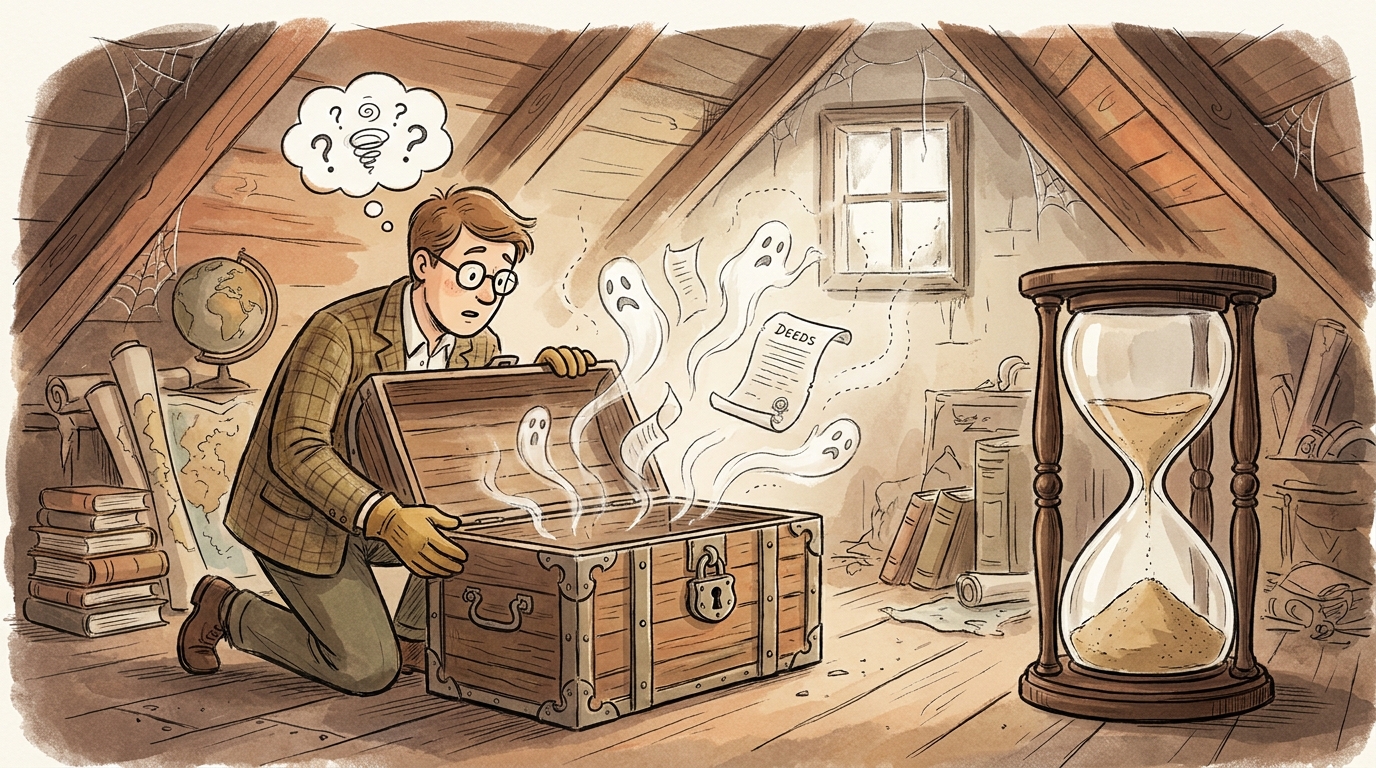
We hear variations of the same story all the time. A family gets a phone call out of the blue. A landman is putting together a drilling unit in Indiana and found their name in the county records. The family is told they might own a fraction of oil and gas rights passed down from a great-grandfather.
They spend weeks digging through old boxes. They find a copy of the original deed. They start doing the math on what a lease bonus or monthly royalty checks might look like.
Then the landman calls back. The title attorneys finished their review. The family does not own the minerals anymore.
The rights were not sold. They were not stolen. They were not seized for unpaid property taxes. They simply evaporated.
Welcome to the reality of Indiana property law. The government does not have to actively take your minerals. It just waits for you to forget they exist.
The Ghost of the Trenton Field
To understand why Indiana law is built this way, you have to look backward.
In the late 1880s, gas was discovered in eastern Indiana. This sparked the massive Trenton Field boom. Almost overnight, Indiana became one of the top natural gas producers in the world. According to the state’s historical records on oil and gas, thousands of wells were drilled. Speculators flooded the state. Farmers sold off their surface land but kept the mineral rights, hoping for future drilling income.
This created a massive web of :severed mineral interest ownership across the state.
Fast forward a century. The original speculators and farmers are gone. Their ownership fractions were divided among children, then grandchildren, then great-grandchildren. Many of these heirs moved away to Texas, Florida, or California. They completely lost track of what they owned.
By the late 20th century, energy companies wanted to explore new formations in Indiana. But they ran into a wall of paperwork. They could not lease the land because the mineral owners were impossible to find.
The state legislature decided to fix the problem. Their solution was brutal but highly effective.
The 20-Year Clock
In 1971, Indiana passed the Dormant Mineral Interests Act. The mechanics of the law are straightforward and unforgiving.
Under Indiana Code 32-23-10-2, an interest in coal, oil, gas, or other minerals is extinguished if it goes unused for a period of 20 years. When the interest extinguishes, the ownership automatically reverts to the surface owner of the land.
The law requires you to actively “use” your minerals to keep them. But what counts as use? The statute is very specific. Your clock is only reset if one of these things happens:
- Minerals are actually produced from the property.
- Operations are conducted for injection or storage.
- Rentals or royalties are paid to you.
- The tract is pooled with another producing tract.
- You pay taxes on the mineral interest.
That last point sounds like an easy out, but it usually is not. Indiana generally does not assess separate property taxes on non-producing severed minerals. If you are not getting a tax bill, you cannot pay it to save your rights.
If you hit the 20-year mark without any of those activities occurring, the lapse is automatic. You lose the asset entirely.
The Supreme Court Ruling: No Warning Required
This is where the law catches most families off guard. When people lose a home to foreclosure or a property to tax sale, they expect a thick stack of certified letters warning them. We are conditioned to believe the government has to give us notice before our property rights are terminated.
In Indiana, you get nothing.
There is no warning letter. There is no public auction. The county recorder does not call you. The 20 years simply expire, and your rights vanish.
Mineral owners understandably felt this was a violation of their constitutional rights. The issue was fought all the way to the highest court in the country. In 1982, the U.S. Supreme Court handed down its decision in Texaco, Inc. v. Short.
The Supreme Court sided with Indiana. They ruled that the state has a legitimate interest in encouraging the development of natural resources and cleaning up land titles. More importantly, the Court stated that property owners are presumed to know the law. The state does not have a constitutional obligation to remind you to manage your own assets.
The burden is entirely on you.
The Paperwork Lifeline
There is one way to stop the clock if your minerals are just sitting there unleased and unproduced. You have to file a :statement of claim with the county recorder where the land is located.
This document must include the name and address of the owner and a description of the land. Filing this piece of paper resets the 20-year timer.
It sounds simple. In practice, it is a massive headache for families.
First, you have to know you actually own the minerals. We covered the complexities of generational inheritance in So You Inherited Mineral Rights: A Survival Guide for the Next Generation. Most heirs do not even know they have an asset to protect until a landman contacts them. By then, in Indiana, it is often too late.
Second, you need the exact legal description of the property. This means pulling old deeds and possibly hiring a local attorney to verify the chain of title.
Third, this is a recurring obligation. The statement of claim only protects you for another 20 years. If a family passes the minerals down to the next generation, someone in that new group of heirs has to remember to file the paperwork again before the next deadline. If they forget, the cycle ends, and the surface owner absorbs the value.
The Quiet Transfer of Wealth
When we look at property law across different states, Indiana stands out. We operate as a family office, meaning we buy and manage minerals with a very long-term horizon. We have seen how different jurisdictions handle old property rights.
In some states, if you are a missing owner, the operator drills anyway and holds your money in a suspense account until you show up. In other states, a trust is set up for unknown heirs.
Indiana chose a different path. They decided that dormant minerals drag down economic development. So they built a system that actively filters property away from absentee families and hands it to the local surface owner.
When an operator finally decides to lease a tract in Indiana, the first thing their attorneys do is check the timeline. They look at the last recorded deed or lease. If it is older than 20 years and no statement of claim is on file, they cross the original mineral owner off the list. They go knock on the door of the farmer or real estate developer who owns the surface.
The surface owner gets the lease bonus. The surface owner gets the royalty checks. The original family gets nothing. The details of how these legal decisions are made behind closed doors is something we explored in The Title Opinion Shadow Market: Why You Can’t See the Document That Controls Your Pay.
Making an Informed Decision
Holding onto family land is a deeply personal decision. There is often a strong emotional attachment to keeping what a grandfather or great-grandmother worked hard to acquire.
But owning minerals in a state with a strict :dormant mineral act requires active management. It is not an asset you can just put in a drawer and forget about. You have to monitor the clock. You have to handle the filings. You have to ensure your children understand the rules so they do not accidentally let the rights lapse after you are gone.
If your family owns a large, highly valuable tract, the legal fees to maintain the filings might make sense.
However, many families inherit highly fractured, smaller interests. The modern value of those small interests might be relatively low. The cost of hiring an Indiana title attorney to draft and record a statement of claim every few decades can quickly eat into whatever future value those minerals might hold.
This is why some families ultimately choose to sell.
Selling is not about giving up. It is about converting a legally complicated, expiring paper asset into real capital. It transfers the burden of tracking the 20-year clock, filing the claims, and monitoring county records over to a buyer whose full-time job is managing those exact risks. We discussed this philosophy in detail in Why We Are Different: The Family Office Advantage.
There is no single right answer for every family. Sometimes the math says hold and file. Sometimes the math says sell and simplify.
The only wrong answer in Indiana is doing nothing. Because if you do nothing, the law has already decided how your story ends.
If you own minerals in Indiana and are unsure where you stand against the 20-year clock, the first step is gathering the facts. You need to know what you own, what it is actually worth today, and what your options are before the calendar makes the decision for you. Having that conversation early brings peace of mind, no matter what you decide to do next.
:severed-mineral-interest
A property situation where the ownership of the underground resources (oil, gas, coal) has been legally separated from the ownership of the surface land. One person can own the farm, while a completely different person owns the rights to the minerals beneath it.
:statement-of-claim
A formal legal document filed in the local county recorder’s office by a mineral owner. Under Indiana law, filing this document proves the owner is actively claiming their rights, which restarts the 20-year clock and prevents the minerals from lapsing back to the surface owner.
:dormant-mineral-act
A state law designed to clear up old property titles by extinguishing mineral rights that have not been actively used or claimed for a specific period of time. These laws automatically transfer the abandoned mineral rights to the current owner of the surface land.