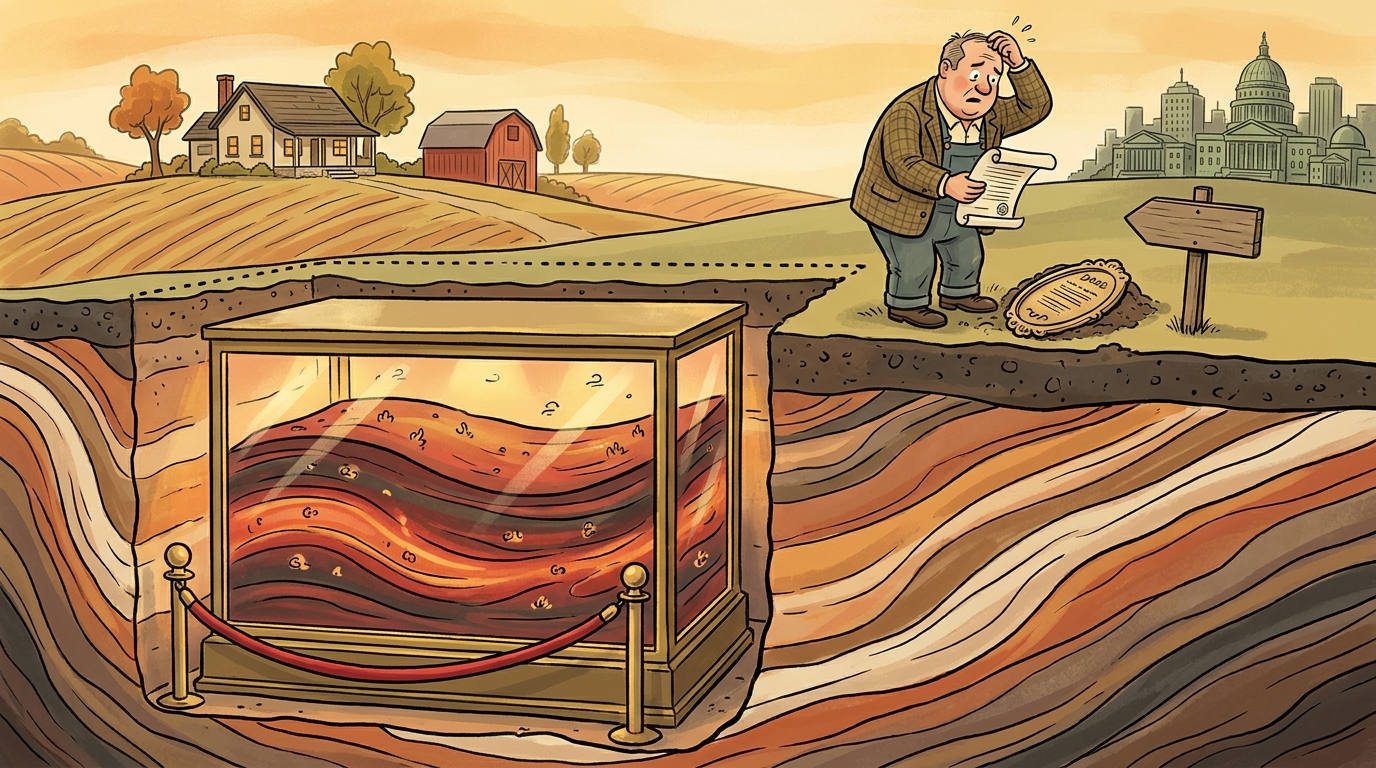
If you own mineral rights in New York’s Southern Tier, your deed likely says you own the natural gas beneath your feet. Legally speaking, it is your property. You can pass it down to your children, you pay taxes on the real estate, and you carry the burden of ownership.
But you do not truly control it. Albany does.
We talk to mineral owners across the country every single week. When we look at a map of the United States, we see a patchwork of different laws, geological formations, and local attitudes toward energy. Most places have rules about how and when you can drill. New York is different. New York has spent the last decade systematically building a legal wall around its massive share of the Marcellus and Utica shale formations, ensuring the gas stays exactly where it is.
The result is brutal for local families. You might own the rights to a geological goldmine on paper. But if the only commercially viable way to get that gas out of the ground is legally prohibited, your asset is virtually worthless. It stops being a financial lifeline and becomes a museum piece.
Now, those property owners are finally pushing back in federal court. Let’s look at how New York stranded its own citizens’ minerals and what this new constitutional lawsuit means for the future of your property.
The Seven-Year Freeze and the End of the Boom
To understand the current frustration, you have to look just across the border.
In Pennsylvania, the shale boom changed the financial trajectory of entire communities. Families who had farmed the same hard ground for generations suddenly found themselves holding multi-million dollar assets. Even with the complexities of Pennsylvania’s minimum royalty laws, the wealth generated in the Keystone State was undeniable.
New York families sitting on the exact same rock formation expected a similar economic windfall. Instead, they got a study.
In 2008, New York effectively paused high-volume hydraulic fracturing to review its environmental impacts. That “pause” stretched into a grueling seven-year environmental review. The state collected an astonishing 260,000 public comments on the issue. Finally, in June 2015, the Department of Environmental Conservation issued a Findings Statement that officially prohibited :high-volume hydraulic fracturing statewide.
The rationale came heavily from a Department of Health review, where officials concluded the state simply should not proceed.
For the oil and gas industry, this was a massive loss of potential inventory. For New York families, it was devastating. People had banked on that future income for retirement, to send kids to college, or to save family farms. Just like we are seeing with the recent urban drilling phase-out in Los Angeles, state and local governments are increasingly willing to strand private property for policy goals.
In 2020, the New York legislature decided a regulatory ban wasn’t enough. They permanently codified the prohibition into state law.
Playing Whack-A-Mole with Extraction Tech
Here is the technical reality of shale: it has incredibly low permeability. The rock is tight. You cannot simply drill a vertical hole and watch the gas flow out like they did in Texas a hundred years ago. You have to stimulate the rock to release the gas.
When New York banned high-volume water fracturing, operators and landowners didn’t just give up. They looked for workarounds. If water was the issue, what about other methods?
The industry proposed using gelled propane. The state responded with an indefinite moratorium on propane gel fracturing.
Then operators looked to carbon dioxide. Using CO2 for completion and recompletion avoids the massive water usage and chemical additives that critics of traditional fracking hate. It seemed like a viable, cleaner compromise that would finally let Southern Tier landowners monetize their property.
New York lawmakers quickly slammed that door shut too. In late 2023 and early 2024, the legislature passed Senate Bill S8357, which explicitly prohibits the state from issuing well permits to any applicant planning to use carbon dioxide to complete or recomplete natural gas or oil resources. The governor signed it, adding yet another layer to the absolute blockade on shale development.
The message from Albany was clear. This was no longer just about protecting groundwater from chemical additives. It was about keeping the fossil fuels in the ground entirely, regardless of the method used, and regardless of who held the title to those minerals.
The Hypocrisy of Energy Imports
The irony of this situation is not lost on the landowners footing the bill.
According to data highlighted by Barclay Damon’s environmental practice, New York imports nearly 85 percent of its energy. A massive chunk of that is natural gas piped in directly from Pennsylvania.
Think about that math for a second. New York state strictly prohibits the extraction of natural gas within its own borders. Yet, to keep the lights on in New York City and heat homes in Buffalo, the state happily buys natural gas from its neighbor—gas that was extracted using the exact high-volume hydraulic fracturing methods New York banned.
The cost of this arrangement falls squarely on New Yorkers. State residents pay residential electricity rates that hover around 40 percent above the national average. Natural gas prices are roughly 22 percent above the national average.
So the state pays a premium to import energy, operators across the border make the profit, and New York mineral owners are left holding deeds they aren’t allowed to use.
The Fifth Amendment Lawsuit: A Turning Point?
When the government takes your property to build a highway, they have to pay you for it. That is a basic tenet of the U.S. Constitution under the Fifth Amendment’s Takings Clause.
But what happens when the government doesn’t take your deed, but instead passes laws that make your deed economically worthless? This is known in legal circles as a “regulatory taking.” And it is exactly what two New York landowners are now arguing in federal court.
On April 16, 2026, a father and son named Thomas and Madison Woodward filed a federal complaint against state officials in the Northern District of New York. The Woodwards bought property in western New York back in 2011, right over the Marcellus and Utica shale.
They did what many savvy landowners do: they created a :severed mineral estate, legally separating the surface land from the oil and gas rights underneath.
Their lawsuit, backed by the Pacific Legal Foundation, makes a very clean, logical argument. Because of the geology of the Marcellus shale, the gas cannot be extracted without fracture stimulation. New York has systematically banned water fracturing, propane fracturing, and CO2 fracturing. Therefore, the state has banned the only commercially viable methods of extracting the gas.
By eliminating the only way to use the property, the Woodwards argue that New York has “taken all economically beneficial use” of their severed mineral estate without offering a dime of just compensation. They are asking the federal court for a :declaratory judgment that these bans violate their constitutional rights, and they want a permanent injunction to stop the state from enforcing the bans.
This is a brilliant, necessary challenge. It forces the state to answer a tough question: if you are going to regulate private property into oblivion for the public good, shouldn’t the public have to compensate the property owners?
What This Means for Your Family’s Minerals
If you own minerals in New York, you are probably watching this lawsuit very closely. Environmental groups will certainly fight it aggressively, citing climate goals and local ecology. But if the federal courts agree with the Woodwards, it could be the biggest shockwave to hit the Appalachian basin in a decade.
A ruling in favor of the landowners would likely force one of two outcomes. Either the state has to lift the bans and let operators drill (sparking a massive, delayed shale boom in the Southern Tier), or the state has to write massive compensation checks to every single mineral owner whose property value they destroyed.
Neither of those will happen overnight. Federal litigation moves at the speed of a glacier. Appeals are guaranteed. The Supreme Court could eventually get involved.
So where does that leave you today?
We meet a lot of families dealing with “stranded” assets like this. The hardest part is the uncertainty. You have this asset in your portfolio or your family trust. You know it has vast potential value, but its current cash flow is exactly zero. It sits there, sometimes complicating probate, sometimes causing arguments among heirs about what to do with it.
You generally have a few paths forward when dealing with legally stranded minerals:
First, you can hold the line. If you don’t need the money and the asset isn’t causing administrative headaches for your estate, you can wait for the courts. You let the Woodwards fight the good fight and hope that five or ten years from now, the bans are lifted and leasing activity explodes.
Second, you can begin estate planning around the reality of the asset. If you are passing this down to the next generation, they need to understand the legal context. They need to know that this isn’t a quick-cash inheritance, but a long-term legal hold.
Finally, some owners look to sell to buyers who are willing to take on the political and legal risk. The valuation of stranded minerals is difficult. You are essentially pricing a lottery ticket based on federal court outcomes. It requires a buyer who understands the exact geology, the pending litigation, and has the capital to wait decades if necessary.
Moving Forward
These decisions carry real emotional weight. Family land is never just dirt and rock; it is a legacy. Having a state government tell you that your legacy must remain locked underground is deeply frustrating.
We watch these markets closely because we have to. Understanding the legal risk is just as important as understanding the geology when evaluating a mineral portfolio. New York is arguably the most hostile state in the country for mineral owners right now, but this new lawsuit proves that landowners aren’t going quietly.
Knowing what you own, and understanding the external forces acting upon it, is the only way to make sound financial decisions. Whether you plan to hold onto your New York minerals for the next generation or you’re just curious what a risk-adjusted valuation looks like today, it’s always worth having a conversation to understand your options. You deserve to know where you stand, even when the ground underneath you is legally frozen.
:hvhf
High-volume hydraulic fracturing (HVHF) is an extraction technique that injects massive amounts of water, sand, and specific chemicals at very high pressures deep underground. The pressure fractures tight rock formations, like shale, creating pathways for trapped natural gas and oil to flow back up to the wellbore.
:severed-mineral-estate
A severed mineral estate exists when the ownership of the underground oil, gas, or minerals has been legally separated from the ownership of the surface land. This means one person can own the right to farm or build on the dirt, while a completely different person or company owns the right to drill beneath it.
:declaratory-judgment
A declaratory judgment is a binding ruling from a court that legally resolves a dispute or defines the rights of the parties involved, without necessarily ordering any specific action or awarding damages. In mineral rights cases, it is often used to definitively establish whether a specific state law violates a property owner’s constitutional rights.